
Stop Explaining. Let the Rep Ask First.
Play Before Explanation — what changes when athletes act before you talk

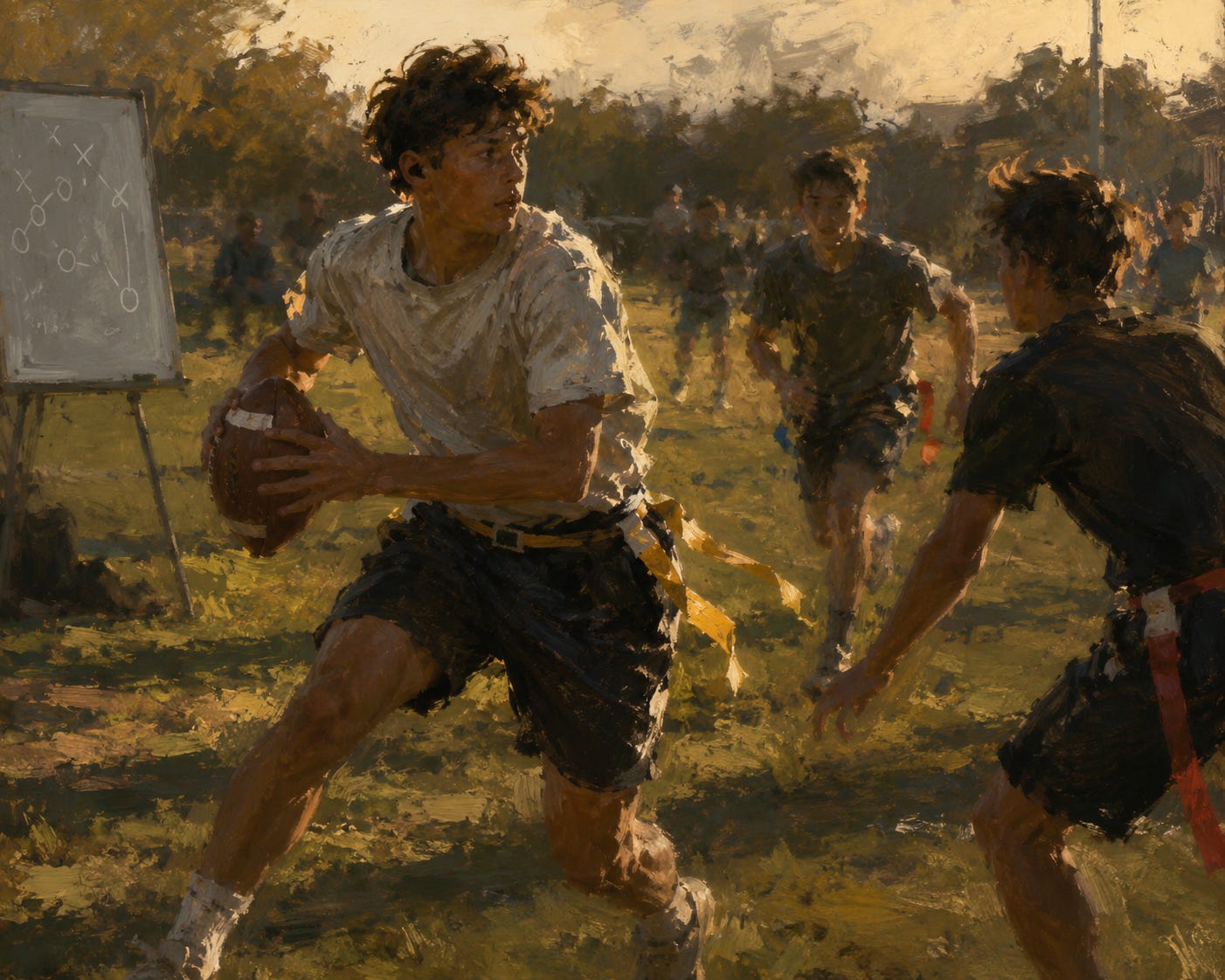
The coach is mid-sentence, marker squeaking across the whiteboard, tracing a route and talking through the read. Eight players are half-listening. One is tying a shoe. A few sets of eyes have already drifted out to the field.
The solution is delivered clean and complete. It lands on no one.
Cut to the same group an hour later. Ball snapped, three seconds on the clock, the defender shading inside. A kid has to choose now. The choice is ugly — early break, wrong shoulder, almost a turnover.
It is also the first thing all session that everyone actually watched.
3 Key Takeaways
You can borrow an answer. You have to build a skill. Understanding a solution and producing it under pressure are different capacities. One you can be handed in a sentence. The other only grows from trying, missing, and trying again.
The struggle to produce the answer is what installs it. When someone reaches for a response and almost finds it, that reach does the teaching. Hand over the answer first and you quietly skip the part that sticks.
Real learning shows up in behavior, not in nodding. Nodding means the words were understood. Changed behavior on the next attempt means something was learned. Watch the second one.
2 Thought-Provoking Questions
How much of what you explain out loud could the situation itself be asking instead?
What would change if your voice arrived after the attempt rather than before it?
What the Whiteboard Can’t Reach
I used to open every drill talking. It felt responsible. It looked like teaching — the diagram, the cues, the clean walk-through before anyone moved. And it produced a room full of nodding heads.
Then the ball would snap and the nodding meant nothing.
A player can repeat the coverage read back to me perfectly at the board. Then the safeties actually rotate, and the same player freezes. The words were there. The capacity to use them was not.
The whiteboard answer can be borrowed. The rep’s answer has to be built.
This is the gap I kept stepping over. Understanding a solution and being able to produce it under pressure are two different things. One can be handed across in a sentence. The other has to be grown, slowly, inside the moment that demands it.
The reframe took me years to trust: the moment an athlete reaches for the answer is the learning event. The reaching does the work. When I pre-load the answer, I take that reach away — and with it, the part that actually lasts.
Designing the Rep to Ask First
Once I saw it, my job changed shape. I stopped trying to deliver solutions and started building situations that demanded one. The environment became the question.
A few things carry more than my voice ever did.
Small-sided games surface the problem on their own. A 3v2 forces a numbers read without anyone explaining what a numbers read is. Narrow the field and separation becomes the only way through.
Scorekeeping turns into a quiet teacher. Score the behavior you want noticed, and athletes start chasing it without a single lecture.
Score the behavior you want noticed, and athletes chase it without a lecture.
And constraints force a decision into existence — a touch limit, a time window, a zone that has to be entered before a score counts.
Instead of explaining when to break off a route, I set a rule: the receiver scores double for a catch made behind a defender who bit inside. The “when” answers itself in the rep. Nobody needed me to define it.
Let Them Invent the Wrong Thing First
Here is the part that still feels uncomfortable. Before I label the solution, I let them try and miss.
A clumsy first guess builds a hook to hang the eventual label on. The wrong attempt sharpens their attention to what the situation is actually asking — far more than my clean explanation ever did.
What they discover, they keep. What they’re told, they borrow.
A defender who guesses wrong on a play-action fake learns the tell faster than one who was simply handed the tell. The miss attunes them. And the invention is still acting before instruction — the rep tests the athlete before I ever speak.
The method here is mostly restraint. Keep your hands off the answer for one more rep than feels comfortable.
Hold the cue one rep longer than feels comfortable.
Feedback After Action, Not Before
The placement of my voice turned out to be the whole game.
Spoken before the rep, the cue pre-empts the test. It answers a question the athlete hasn’t asked yet, so it lands flat. Spoken after the rep, the same cue arrives at someone who now genuinely has a question — and it lands.
So I hold the cue until there’s something to react to. Then it comes short and specific: “What did you see right before you broke?”
Silence during the rep stopped feeling like a failure of coaching and started feeling like part of the design. The quiet is where the athlete does their reaching.
And this is the relief I didn’t expect. My voice no longer has to carry the entire session. The environment carries it. I get to edit.
🙋♂️
If something I made helped you in any way, however small, I’d love to hear what changed or what you built with it. That reflection is what keeps this work breathing.
Redesign One Drill This Week
You don’t need to rebuild your whole practice. Pick one drill you currently open with explanation, and convert just that one.
Name the single decision you want the athlete to make. Build a constraint, a score, or a numbers imbalance that forces that decision inside the rep itself. Run it cold — no setup talk beyond the rules — and let the first attempts be rough. Place your feedback after the rep, as a question about what they noticed. Then run it again, and watch whether the behavior changed, rather than whether they nodded.
Keep it to one drill. The shift is small in scope and surprisingly large in feel.
Paths in Grass
Go back to the two whistles. The kid who broke early and ugly on that first snap — three reps later, the read comes clean. The shoulder is right. The timing is right.
And no one explained it to them between then and now.
Learning showed up in behavior, not in nodding.
The coach talked less, and the athletes saw more. The paths got worn into the grass by feet that walked them, not by a marker on a board.
Try the one-drill redesign before your next session. Notice where your own voice was doing work the environment could have done on its own.
🌀
What’s the first idea this unlocked for you? Leave it in the comments, please, or send me a quick message. I don’t want what I publish to vanish into the void.
Rolf is a non-linear pedagogy advocate, author, and coach developer from Germany. He writes about humane coaching, purposeful change, and the road toward dreams worth chasing.
If his work resonates, why not walk a stretch of the road with him?
📌 PS: If you found this post helpful, would you please consider restacking it and sharing it with your audience?This post is public, so feel free to share and forward it.
I love coffee ;-)
LinkedIn
Instagram
Email: info@flag-academy.com
Email: rolf@beyondchampionships.eu
Facebook: Coaching Beyond Championships
Related Reading:
The Drill Requires Constant Explanation. The Game Explains Itself. - The companion case for letting the game do the teaching the drill keeps demanding from your voice.
What the Game Is Actually Asking Athletes to Notice - A closer look at the perceptual questions a well-built rep asks on its own.
Hub 1 — Game-First Practice Design - The wider map this essay sits inside, for designing practice around problems rather than instructions.