
Beyond Drills: How Kids Actually Learn the Game
How We Turn Practice Into the Best Part of the Kids’ Week

The myth is that the cleanest practices are the best ones. Lines of kids waiting their turn, cones arranged with military precision, whistle after whistle signaling order. Coaches look in control, parents relax, everyone feels progress is being made.
The truth is, those practices often drain the life out of sport. Kids don’t come back for cones. They come back for touches, for laughter, for sweat that leaves them glowing. They come back to tell their parents, “Time went by so fast.” That is what sustains them. And us.
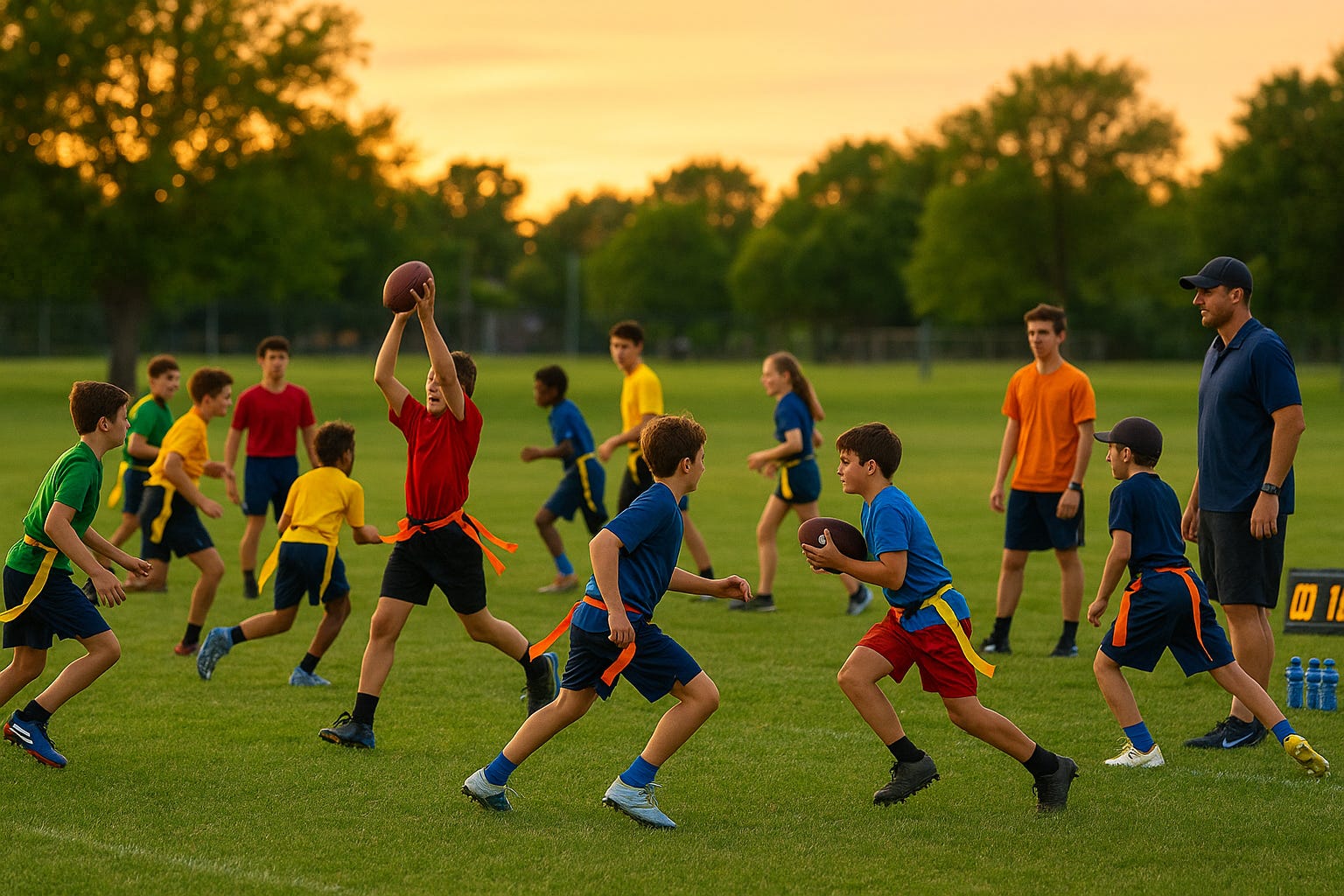
Last Monday night, I stood in the middle of our club’s joint practice—U11 and U13 flag footballers, next to twenty kids, three teen assistants, the head coach, and me, filling the role of veteran coach and coach educator. We used to run 120-minute sessions, but cut them down to 90. The shorter practice is quicker, sharper, more alive. Our organizing principle: keep every child moving. Max idle time is the walk back to the line of scrimmage.
What follows is not theory, not opinion. It is a practice as we run it. I did not make a best-of, it’s exactly what happened one session. You will see why we run it this way.
3 Key Takeaways:
Shorter, faster practices keep kids active and engaged, with minimal idle time.
Designing activities around game-like situations builds decision-making and adaptability.
Coaching joy grows when older players return as assistants and the ecosystem sustains itself.
2 Thought-Provoking Questions:
What part of your current practice design quietly encourages standing around instead of learning?
How would your team change if you valued development and belonging above the scoreboard?
A Monday in Motion
We begin with a five-minute huddle. The head coach announces the focus point of the day. Kids check our safety rules—yes, the kids, not us coaches. Then reminders about looking out for each other. Newcomers are welcomed.
Then ten minutes of flag-specific warm-ups. Not a parade of static stretches. These are dynamic, playful movements tied to what they will actually do later: quick footwork into cuts, turns with eyes on an imagined quarterback, catch-man shuffles. I lean on the concept of Periodisation of Skill Training here, treating warm-ups as the “coordination phase” (Otte, Millar, Klatt, 2019). They look like movement puzzles, because that’s what the kids need at the start: switch on coordination, feel for their moving bodies, and readiness at the same time. In PATE terms, this is mostly E1xT1/2, but reaches E3xT2 at times.
We jump into a five-minute flag-pulling game with fluid roles. PATE: E4xT3/4. Small, simple, just enough to shake off the day and bring smiles, heavy breathing and the urge for ...
Water break.
Then comes the heart of the session: two 15-minute group blocks. Most often, U11 and U13 are split, each with one or two coaches. On this day, the focus is separation—learning how to create it on offense, how to deny it on defense. That shared lens keeps practice coherent even though kids switch groups and sides all the time. I will give you more details in a minute.
Another short water break.
Scrimmage fills the final third. We divide into as many 2v2 or 3v3 games as the numbers allow, sometimes on reduced fields with quirky rules. One game might reward interceptions with double points. Another might require receivers to switch. Yet another might ask for advancing the ball enough in just two or three downs. Toward the season, we’ll shift to 5v5 to polish mechanics and rules. But these small-sided scrimmages are where the kids take over more of the organization, more of the decisions. The cues from coaches become fewer, softer. Autonomy grows.
We finish with the last huddle. Too often this becomes a lecture on “how good practice was.” We fight that urge, but lose to our own egos most of the time. Then, players give praise to other players. The volunteer ‘flag monster’ collects belts. A simple break of the huddle, and the practice is done.
Ninety minutes, fast. Messy at times, but deliberately so.
What Happens Inside the Activities
Quarterbacks arrive early for mechanics and decision work. They’re few in number, so one coach gathers them. All ages together.
Group A begins with routes on air. Every player runs not more than two reps with no defense, focusing on timing of cuts and catching windows. Quickly it evolves into 1v1. We limit to route families—say, slants and shakes—so that kids explore variation within boundaries. It’s about coordination with a live opponent, not choreography. In PoST, this is about adaptation and some performance. In terms of the PATE matrix, we want to advance toward its lower right corner always a little earlier than feels comfortable.
Group B plays 2v2 man coverage on reduced fields. One assistant throws the ball when we don’t have a quarterback in that group, or when they want to be receiver or defender. The rules keep changing. This week: cross a vertical lane before catching earns you a bonus point; interceptions worth two. Kids argue cheerfully about the rules, but they internalize them fast. Constraints like these come straight from ecological dynamics and nonlinear pedagogy. They shape movement behavior and learning without us having to instruct it. In PATE terms, clearly E4xT4.
The coaching style is rapid-fire cues: “Win the first two meters.” “Late hands.” “Point for the breakup.” Rarely do we stop the activity. The goal is to maximize touches. Each player should feel the ball, feel the contest, over and over. We rather obsess about adjustments of dimensions, numbers, scoring rules than about instruction. Coaches need to see first and foremost, then facilitate everything towards the session intention.
Scrimmage then is almost a verification phase, we assess if players learned something. Here, cues shrink even further. Coaches hold back. The idea is self-organization. Sometimes we need to remind them to hurry between plays, so we’ve begun experimenting with play clocks. They love the responsibility, even if chaos rises. Pure E4xT4.
The Counterpoint
Compare this to what many youth practices look like: blocked drills, agility ladders, long lines. On the PATE matrix, I mean E1xT1 to E2xT2, so the upper left-hand corner.
I once attended a U9 practice in the U.S. where the two lone coaches had 37 (thirty-seven) kids waiting their turn in an orderly line for their 1v1 tackling drill. No speaking. Five live touches of an opponent per kid per practice. I can’t remember if they used a ball at all.
It’s not that agility ladders, cones cemeteries, or lines are inherently evil. The problem is what they don’t do. They don’t present decisions. They don’t adapt to opponents. They don’t resemble the information athletes will need in a game. They don’t afford coordination mid-play. The only emotion they raise is embarrassment over imperfections. Ladders might improve rhythm for dance or marching, but in flag football? They give kids 2% of the picture. We have to stop mistaking that 2% for the whole.
Blocked repetition creates a sense of security: you know what’s coming, you feel good executing it. But security is not the same as learning. We learn from differences, not sameness.
When you hear “but they could do it in practice!” from an opponent coach on game day, they just allowed you a glimpse into their practice session.
Reflections in Real Time
This all sounds neat in theory, but practice is messy. We struggle to get kids into groups of three, four, five quickly. We waste time onboarding newcomers. We lose momentum in scrimmages when offense can’t organize. Scoring and marking downs can be clumsy.
Yet we are proud of what happens anyway. Retention is above 95% year to year. Younger siblings join in when old enough. Two to three players each year, after aging out, come back to coach. They spend the same hours we do, but as teens, giving back to the kids they once were. That is my greatest joy: coaching them coaching.
Parents tell us kids count down days to practice. Some say practice is more exciting than games. We once promised ourselves: practice will be the best part of the week.
And the outside world notices. Opposing coaches compliment our teamwork. Parents from other clubs thank us for fair competition.
Not every outcome is rosy. Some kids leave at U13. A small portion stop playing altogether. More often, they move to U16 tackle football and abandon U16 flag. The roster gets thin. Girls are underrepresented, though those who do play often shine as natural teammates and just overall awesome athletes. Transfer to the state select team is rarer than I’d like. The Olympic push in the U.S. hasn’t yet touched us.
And yes, the elephant: do we win enough games? Over the years, our record floats between .250 and .750. Respectable. Not dominant. For some adults, this stings. But our kids don’t carry the sting. They play with joy, unfazed.
The Wider Frame
So what does transfer? Not necessarily more wins. But joy does. Retention does. Care for each other does. Kids stepping into coaching does.
Ecological dynamics describes learning as a dance between athlete and environment. Perception and action must be coupled. Variability fuels adaptability. Representative design means practice must contain the cues, pressures, and emotions of the real game. Our practice tries to live in that space—not as a manifesto, but as a weekly ritual where kids are active, connected, alive.
It is less about drilling fundamentals and more about defining the new behaviors we value and training to them. Safety rules spoken by kids. Praise given peer to peer. Teen assistants learning to guide, not command. Scrimmages that teach autonomy rather than obedience.
Practice is not just about skill, but about building an ecosystem. Every detail—warm-up design, feedback style, scrimmage rules, who speaks in the huddle—shapes the climate kids grow in.
This isn’t the only way to run a practice, but it’s a fun option—and it’s the way I prefer.
So, dear reader, if we ever speak to each other, please do not ask me: What drills did you run? Please ask: How alive was your practice?
Rolf is a non-linear pedagogy advocate, author, and coach developer from Germany. He writes about humane coaching, purposeful change, and the road toward dreams worth chasing.
If his work resonates, why not walk a stretch of the road with him?
📌 PS: If you found this post helpful, would you please consider restacking it and sharing it with your audience? This post is public, so feel free to share and forward it.
My Payhip Store
LinkedIn
Instagram
Email: info@flag-academy.com
Email: rolf@beyondchampionships.eu
Facebook: Coaching Beyond Championships
Wow Rolf- just wow! I felt the need to read through quickly to match the energy of the session- so much packed in there. I try to do a very similar thing with my sessions- but, quite clearly, not as jam-packed as this. The chaos is exciting- except it isn’t really chaos is it?! The children know what’s going on- it just looks chaotic if you don’t understand what’s actually going in. No wonder the players look forward to every session!