
You Almost Fixed a Throw That Worked.
The Form Illusion — a coach’s quiet bias for the textbook picture, and what it costs.

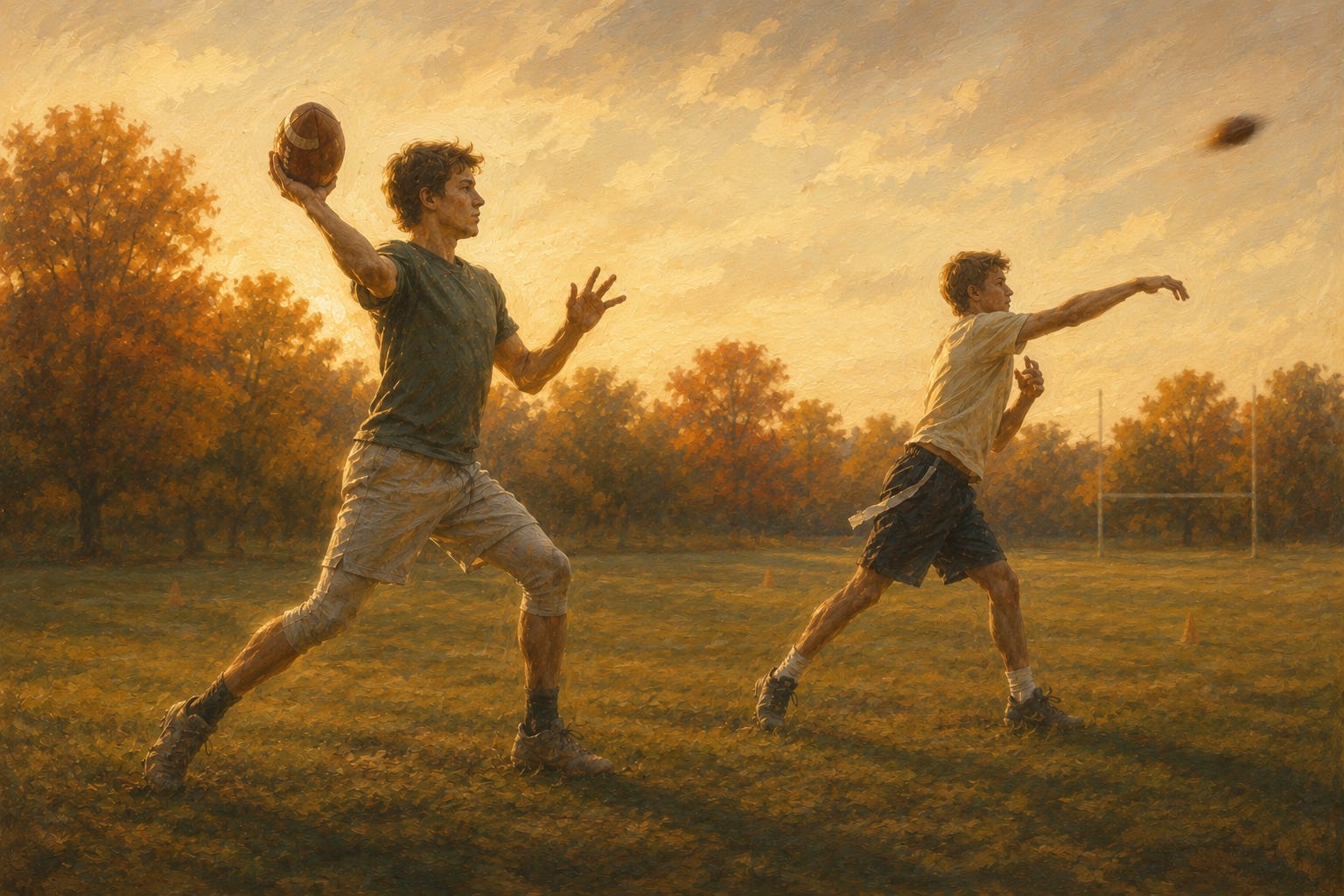
There is a young quarterback I keep thinking about. His motion is the kind you could photograph for a clinic poster — elbow up, hips opening on time, the follow-through finishing exactly where the manual says it should. The ball leaves his hand and hangs in the air looking like everything you ever wanted a throw to look like.
Then the play happens. The ball arrives a half-second late, telegraphed across his body, floated just enough that the receiver has to break stride and wait for it. The defender, who read the whole thing, is already closing.
Beside him stands another kid. His throw has a hitch nobody likes. The ball wobbles. And it is on the receiver before the defender has finished turning his head.
So here is the small, uncomfortable question. Watching those two boys throw, which one did your eye reward first?
3 Key Takeaways
The eye scores resemblance before it ever checks the result. You carry a picture of what skill is supposed to look like, and you grade whatever you see against that picture. The closer something matches, the more capable you assume it is — long before any evidence shows up.
What looks clean is easy to praise. What works is harder to see. Polish is legible and photographable. Function hides inside timing, deception, and a decision made a beat early. Praise flows toward the part you can see, so people learn to perform the picture instead of solving the problem.
Before fixing something, watch it under real pressure. If the outcome holds when the stakes are live, the form is already doing its job. The thing that looks unfinished is often the thing that’s working — and quietly ahead of the thing that photographs well.
2 Thought-Provoking Questions
When you watch someone perform, are you measuring what they did, or how closely they resembled the picture in your head?
What if the rep you keep wanting to clean up is the one that’s already winning?
The Eye Wants a Picture
We all carry a snapshot of what skill looks like. It got built quietly, over years — from highlight reels, from coaching manuals, from the handful of players who happened to look the part on the day someone was watching. The snapshot feels like knowledge. Mostly it is memory of appearance.
And we score live players against it. The closer the player resembles the snapshot, the more skilled we decide they are. Resemblance does the judging before the evidence arrives.
Resemblance does the judging before the evidence arrives.
Kahneman has a name for this shortcut. We reach for the representativeness heuristic — we treat the thing that looks like the category as a member of the category. The smooth-looking dribbler in soccer must be the better ball-handler, right up until the moment pressure arrives and the ball squirts loose. The “natural athlete” must read the game well, until the defense shows him something he can’t decode. The clinic-perfect catching drill must build catchers, until the first time a body crosses the receiver’s frame in traffic.
The snapshot was assembled from a sample already tilted toward the photogenic. We trained our eye on the players who looked the part. Then we use that eye to find more of them.
Aesthetics Seduce the Coaching Eye
The pull toward clean form is strong, and it is worth being honest about why. Clean form is legible. It is photographable. It is easy to praise on a Tuesday and easy to defend to a parent leaning on the fence on Saturday. A smooth throwing motion gives you something to point at and say, there, that’s what we’re building.
Function under pressure offers you almost nothing to point at. It lives in timing. In the half-yard of separation. In the deception that makes a defender lean the wrong way. In the decision made one beat before everyone else made theirs. None of that holds still long enough to photograph.
Praise flows toward what looks right.
So praise flows toward what looks right — and people are not stupid. They feel where the approval lands. Slowly, without anyone deciding it, the player starts performing the picture for the coach instead of solving the problem for the game. The receiver with the textbook footwork gets the nod. The one with sloppy feet who is simply, maddeningly, always open gets a note about their feet.
When the Picture and the Outcome Disagree
The real trouble starts when we keep coaching toward the snapshot even after the scoreboard and the film begin to disagree with it.
This is where I have watched good coaches spend a whole season smoothing a fast, ugly release into something clinic-clean — and watch the completions quietly leave with the hitch. We sand down the quirk that was releasing the ball early. We call it development. On paper, it is. The player now resembles the picture far more than he did back in April.
The corrected player looks more coached, and the result quietly disappears.
That is the part that makes this bias so expensive. The corrected player looks more coached. The productivity is real to the eye and absent in the result. Nobody files a complaint, because nothing visibly broke — the throws are prettier than ever. They just don’t get there in time anymore.
🙋♂️
If something I made helped you in any way, however small, I’d love to hear what changed or what you built with it. That reflection is what keeps this work breathing.
What the Functional Coach Watches Instead
The shift is smaller than it sounds, and it lives in the question you ask. Move from does this resemble correct form? toward did the ball get there, on time, against this defender?
Function only tells the truth under load. Read it at the moment of pressure — with a defender closing, a clock running, a tired body, a real decision on the table — not in the still frame where everything looks fine. Judge a pass by where and when it arrives. Let an individual movement solution stand if the outcome keeps holding. And when a player’s motion looks variable, consider that you might be watching someone search for what works rather than someone failing to do it the one right way.
The eye was never lying about beauty; it was answering a different question than the game was asking.
Representativeness has a sibling. Sometimes a vivid anecdote stands in for the weight of actual evidence — that’s the trap I followed in He Did It Once. Out of How Many?, the first half of this little pair. Appearance outweighing function, anecdote outweighing data: between them they explain why linear coaching can feel so completely right while it quietly steers you wrong.
A few ways to keep your own eye honest, starting at the next session.
Watch before you correct. Before touching a movement, see it under game-relevant pressure once or twice. If the outcome holds, the form is doing its job — leave it alone.
Separate the snapshot from the score. Say out loud what you’d praise from the sideline, then go to the film and check it. Notice the gap between the two.
Give feedback on what the ball, the body, or the decision actually did, before you say a word about how it looked.
Track yourself for a week. Note who you praised first. If the pretty reps keep winning, the bias is the one coaching, not you.
And protect the ugly-effective rep. The player whose solution works but doesn’t photograph well is usually ahead of the room, not behind it.
The Throw You Almost Fixed
I keep coming back to those two quarterbacks, and to the coach standing between them with a clipboard and the best of intentions. Picture him a season later. The fast, ugly release is gone. The motion is clean now, defensible, exactly the picture. And the completions went with the hitch.
His eye was never lying about beauty. It was answering a different question than the game was asking — and answering it beautifully.
So this week, find the one player you keep wanting to clean up. Before you say anything, watch only the outcome for three reps. Just the ball, just the arrival, just whether it worked. Then decide whether the thing you wanted to fix was ever broken.
🌀
What’s the first idea this unlocked for you? Leave it in the comments, please, or send me a quick message. I don’t want what I publish to vanish into the void.
Rolf is a non-linear pedagogy advocate, author, and coach developer from Germany. He writes about humane coaching, purposeful change, and the road toward dreams worth chasing.
If his work resonates, why not walk a stretch of the road with him?
📌 PS: If you found this post helpful, would you please consider restacking it and sharing it with your audience?This post is public, so feel free to share and forward it.
My Payhip Store
I love coffee ;-)
LinkedIn
Instagram
Email: info@flag-academy.com
Email: rolf@beyondchampionships.eu
Facebook: Coaching Beyond Championships
Related Reading:
The End of Correct Biomechanics - Why chasing one “correct” technique sands off the solutions that actually work.
The Perfect Movement Model? Please. - A closer look at the ideal-form picture we keep coaching toward.
The Safety Paradox - The prior Kahneman-bias piece in this series.