
Three Hours, No Lines, All Learning
U16 against first-leaguers; rotating rules, tight fields, and why engagement never dipped

Three hours.
No drills.
No lines.
Just the game—in all its unpredictable beauty.
Last weekend, our U16 squad, average age barely 13½, shared the field with the Renegades—a first-league flag football team of grown men. They matched us in numbers, we played every snap as opponents, and what unfolded was one of the most joyful and revealing sessions I’ve ever coached.
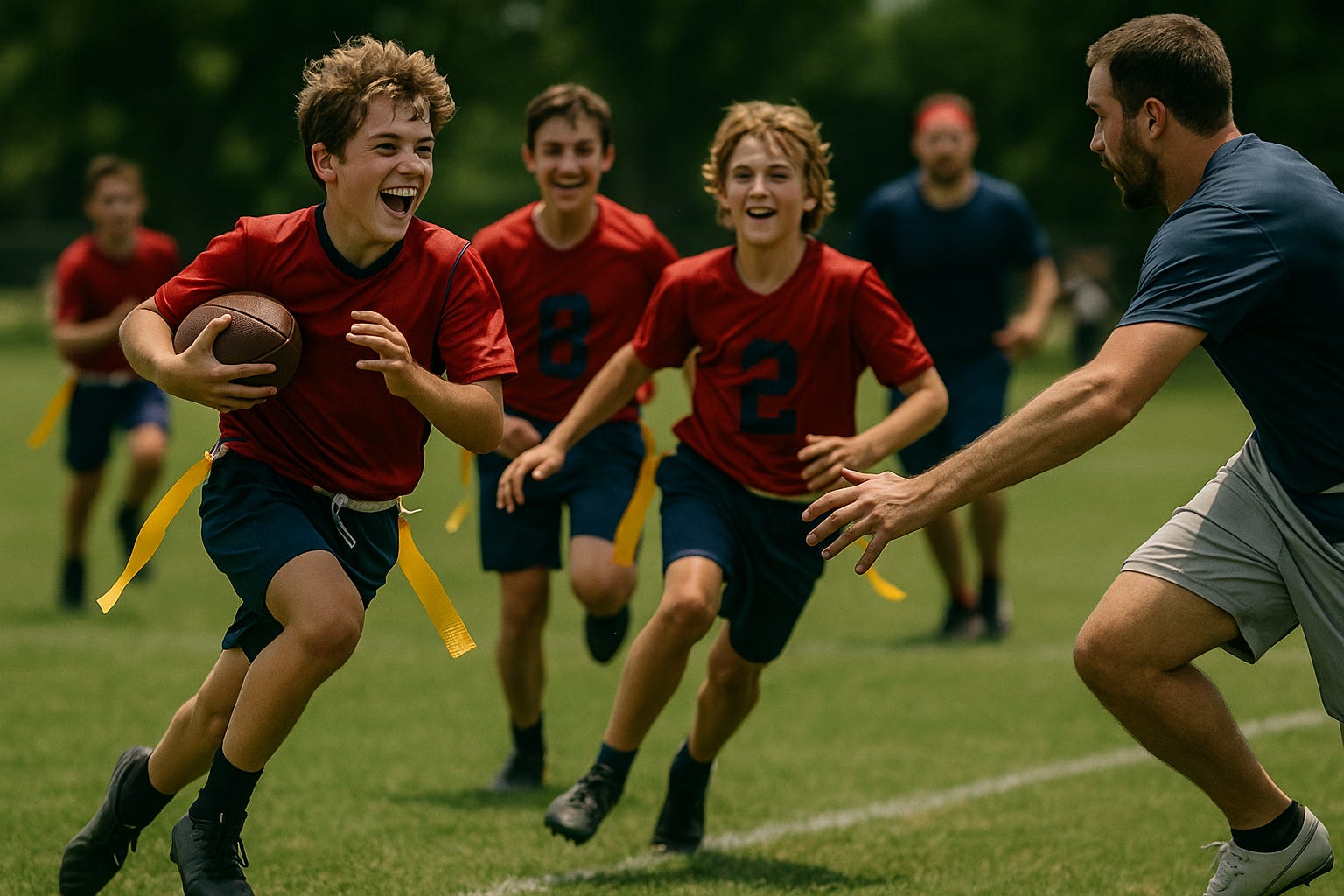
Learning thrives on interaction & transaction, not instruction. When players face real decisions under shifting constraints, skill and understanding evolve together—no lecture required.
Small-sided chaos builds big-picture intelligence. Games like 3v3 or 4v3 multiply meaningful touches and force players to read cues the way they must in real play.
Belonging is the hidden performance enhancer. Shared language, trust, and laughter aren’t extras—they’re the conditions where fearless learning happens.
2 Thought-Provoking Questions
What would happen in your environment if you stopped “teaching technique” for a week and let the game itself drive discovery?
How might your players design their own constraints to challenge each other—without you stepping in?
The Setting
We played continuously for three hours, shifting through small-sided versions of the game—3v2, 3v3, 4v3, and 4v4. Each block brought a new set of constraints to stretch perception and decision-making: field sizes from 10×10 to 25×25 meters, silent drives versus communication-only, surprise end zones announced at the snap, blitz pressure, “must-pass-short” YAC challenges, and rotating scoring systems rewarding teamwork or communication.
Details? Scroll way down.
Every format demanded adaptation. There was no chance to switch off, no idle time waiting in a line. Each player took around 150–180 snaps, compared to the 20 or so they’d play in a league game. The rhythm was relentless—fast, demanding, alive.
And yet, the energy never dipped. They went full speed all the time, smiling through fatigue. If we had a “smiles per hour” metric, this practice broke every record.
The Learning Inside the Chaos
Disclaimer: These kids were not beginners anymore. They all had practiced and played the game for two years or more.
So we didn’t talk about “form” or “technique.” We talked about reading—what space the defense gives, what leverage your opponent shows, where the opportunity hides. The game itself became the teacher.
In ecological terms, this is how athletes learn best. As Rob Gray, Keith Davids, Wolfgang Schöllhorn and many others have shown, adaptable skill emerges not from repeating ideal movements, but from exploring variations under real constraints. Every pass, every route, every coverage changes slightly. Players self-organize solutions that fit the moment—just as they must in competition.
And you could see that happening in real time.
The kids started identifying mismatches, adjusting depth and timing without prompts, making defensive switches uncoached. They compared themselves to elite play—short videos from the German Men’s National Team, which we used to show what elite-level recognition looks like. Suddenly, what they saw on screen matched what they felt on the field. That’s perception-action coupling in action.
Want to know exactly how we structured this transformative session? Scroll way down for a view Inside the Session: How We Built the Game.
Competing With the Adults
Physically, the gap was obvious: the adults had more size and strength.
But in two other athletic dimensions—speed and agility—the kids were right there, often better. The Renegades had to work hard to adjust to the agility, timing, and relentless energy of the youngsters.
The result? A 40-minute competitive block—20 minutes offense, 20 defense—that ended in a tie. OK, we doctored the tie a bit, but that was just because the adults scored on the last play to go ahead.
More important than the score was the connection. The adults kept giving high fives in admiration, and our players beamed with pride. You could sense that something shifted: the belief that they can compete with anyone if they play smart, adapt fast, and trust their teammates.
Maybe one more thing: I was afraid that the adults looked down on the kids; even a “wow, you can cover really great already” could have signalled their superiority. Instead, they simply respected their skills and effort, creating a mutual admiration that transcended age.
🙋♂️
If something I made helped you in any way, however small, I’d love to hear what changed or what you built with it. That reflection is what keeps this work breathing.
What I Felt as a Coach
Personally, this was one of those rare sessions where I was fully inside it—not hovering outside, analyzing, but present with my players for three straight hours. Coaching through play rather than over it. No lengthy technical or tactical instructions, no motivational speeches, just shaping the environment and letting learning emerge. Most time I spoke was to announce new rules or the score.
It was exhausting and exhilarating in equal measure. The kids pulled me into their rhythm—into that beautiful, messy space where learning feels like discovery rather than instruction. By the end, I wasn’t just proud of them. I was grateful. They reminded me why I coach.
Why This Matters
If you’ve followed my writing, you know I’m passionate about the ecological approach—or “ecoD,” as we often call it. It’s not a new method or a trend. It’s a way of seeing learning as something that happens in the game, not before it. It is the state-of-the-art in coaching, and grounded well in sports and learning science.
Instead of isolating skills in controlled drills, we manipulate constraints—field, time, numbers, rules—so players must perceive, decide, and act under real conditions. Over time, that builds attunement, creativity, and resilience far better than prescriptive teaching ever could.
It also makes practice more engaging. The science backs it up: research in team sports consistently shows that constraints-led and nonlinear practice designs accelerate tactical learning and long-term retention. Athletes trained this way don’t just execute better — they think better in games.
In other words, the game doesn’t just test learning—it creates it.
The Ripple Effect
After the session, parents told me their kids came home buzzing—still talking about the plays they made, the moments they outsmarted a grown man, the laughter between snaps. That’s how motivation grows: not through speeches, but through experiences that feel alive.
This group will remember that day for years. It was proof that learning can be demanding and joyful at once. That it should be demanding and joyful. That excellence can come from play. That the game of flag football, even in its small-sided forms, can be both teacher and reward.
Looking Ahead
We’ll continue to explore this “game-first” approach in our U16 program. Each practice will remain built around real game dynamics—smaller numbers, tighter fields, variable rules, changing constraints.
Personally, I will lean even more towards game-first teaching with the U13 and U11 teams I coach. My aim is to keep technical instruction and drilling limited to beginners—for safety, to introduce new patterns, and for managing load. And honestly, if I ever coach select teams again, game-first will be front and center.
If you’re a coach curious about how to design these kinds of sessions—how to turn theory into field practice—I’d love to connect. Whether you’re working with youth players or adult teams, the ecological approach offers something powerful: a way to make every minute of practice more representative of the sport we love.
That day with the Renegades reminded me: the future of coaching belongs to those who can turn learning back into play.
🌀
What’s the first idea this unlocked for you? Leave it in the comments, please, or send me a quick message. I don’t want what I publish to vanish into the void.
Rolf is a non-linear pedagogy advocate, author, and coach developer from Germany. He writes about humane coaching, purposeful change, and the road toward dreams worth chasing.
If his work resonates, why not walk a stretch of the road with him?
📌 PS: If you found this post helpful, would you please consider restacking it and sharing it with your audience? This post is public, so feel free to share and forward it.
My Payhip Store
LinkedIn
Instagram
Email: info@flag-academy.com
Email: rolf@beyondchampionships.eu
Facebook: Coaching Beyond Championships
Inside the Session: How We Built the Game
Our three-hour event wasn’t a “training” in the traditional sense—it was the construction of a learning system. The goal was to help players observe, orient, decide, and act inside real game dynamics while building trust and belonging.
We started indoors, moved onto the field, came back to reflect, and ended in a circle. Each block connected perception, emotion, and tactical awareness—a living version of ecological dynamics on youth level.
Block 1 – The Circle Opens
We began in the gym, football in hand, standing in a circle. Every catch came with a question: What makes a great teammate? What do you bring to this group? What’s a social moment from a past game you remember? What’s a strength you admire in a teammate? and more such things.
It was a human warm-up—connection before competition.
Then we analysed 3 clips from our national team to learn to identify space and how it opens up and closes, based on opponent’s positions and vectors.
Block 2 – Perception in Motion
The next hour or so unfolded in three waves of games, each with specific constraints that nudged attention and coordination in different directions.
1. Warm-up Game – “Affordance Hunt” (≈ 15 min, 3 v 2, 12 × 12 m)
The constraint: before passing, the ball-carrier had to name aloud what they saw – “open space left,” “teammate cutting,” “defender flat.” Did not quite work, but I could make them point to open space while executing the play.
2. Exploratory Game – “Find the Space” (≈ 25 min, 3 v 2 rotating)
Here, attackers tried to recognize and exploit a closing window of space.
Defenders rotated every play, keeping information unpredictable.
Constraints:
offense had max 3 seconds to throw,
catch valid only if the passer had announced the intended window (“left gate,” “middle,” etc.).
Each tweak altered the informational landscape: timing, trust, shared focus.
The feedback loop became visible—when players spoke early, movement became cleaner; when they delayed, chaos returned.
Coach lever: after each mini-round, ask “What changed when the space got smaller?” and adjust field size from 15 × 15 → 12 × 12 → 10 × 10 m.
3. Constraint Ladder – Adaptive Challenge (≈ 15 min, 4 v 3)
We climbed a quick ladder of rule shifts every 3–4 minutes:
1️⃣ Free play – observe baseline decisions
2️⃣ 3-second throw clock – forces quicker perception–action coupling
3️⃣ 7-yard gain requirement – biases toward reading depth and risk
4️⃣ One of two end zones announced post-snap – trains adaptability under ambiguity
5️⃣ Free round – players propose one constraint of their own
The goal wasn’t perfection but attunement – noticing which cues truly mattered.
Block 3 – Culture Lab
In a break, we slowed down to talk about how it feels to belong.
The whiteboard question: “Was wollen wir fühlen, wenn wir Teil dieses Teams sind?” (What do we want to feel when we’re part of this team?)
Out came the words: Vertrauen, Energie, Spaß, Fokus (trust, energy, fun, focus).
Block 4 – Guests & Game
Then came the Renegades. Adults, first-league players—and the perfect mirrors for our kids.
We played continuous 3v3, 4v3, and 4v4 sets with rotating constraints:
normal rules, points-scoring adjusted to session intent,
“Ich sehe…” bonus points for pre-snap reads,
silent drives demanding nonverbal coordination.
The field pulsed with information and energy. You could feel learning emerge.
Later, we flipped sides: our U16 defended, focusing on reading space, not chasing players.
When it all came together in the final 5v5 game, both teams were smiling, sweating, and competing hard—the purest kind of transfer learning.
Block 5 – Closing Circle
We ended where we began: in a circle, quiet, connected.
Each player answered, “Ein Moment, auf den du stolz bist?” and “Was hast du über uns gelernt?”
(One moment you’re proud of? What did you learn about us?)
The answers were thoughtful, sometimes shy, often profound.
“Belonging isn’t what we get. It’s what we create—every time we listen, speak, or act with purpose.”
That’s how we closed—not with tactics or stats, but with shared emotion and reflection.
Your articles is what brought me to the ecological approach to learning btw. I would not have the success and fun I’m having without your articles. My goal at the beginning of the year was to be a legendary coach for these kids and I feel like I am actually fulfilling that goal with your help.
I want to share a moment from my tour mane this last weekend. We as an underrated 2s team achieved a top 2 finish for the 3rd time in tournament results this year. We had the chance to uprank 3 times. We almost got into the top of teams rated in our area.
In our last game yesterday, we had a crazy moment. We were up 10-2. We had to get to 15. They called a time out. I could feel victory.
But something changed on the court. Everyone looked scared. It felt like we didn’t want it. People started screaming with a different feel. Imposter syndrome set in. We were up so much. Then I realized that we never trained for this moment.
We never trained for the moment to be up so much. This had a different psychological feel. We lost. We were not prepared for this moment. I failed as a coach for not recognizing this lack of experience. Just past tournament this happened as well.
The next day I woke up and that’s the first thing I remembered. The grief set it. We were up 10-2.
I was sad but determined. We had practice today. I knew we had to train this. If we trained this. We will be unstoppable. All 2 hours. Games to 15. 0-8 start scores. Loser does a suicide.
Seeing the boys fumble the lead at practice gives me joy because I know the other side is learning how to attack the point gap.
Seeing the 8 point side destroy the 0 point team felt useless but I am seeing them realize urgency.
Seeing them manage risk in their serve and hit. Seeing them communicate urgency. Seeing them understand how critical it is to error is EXACTLY what we need.
Thanks to your articles, I can be that legendary coach and not let this failure define my team.
Very cool to read this. Infectious.